Technology
STC-Rated Doors: STC 35, 40 and Acoustic Door Ratings
14 August 2026
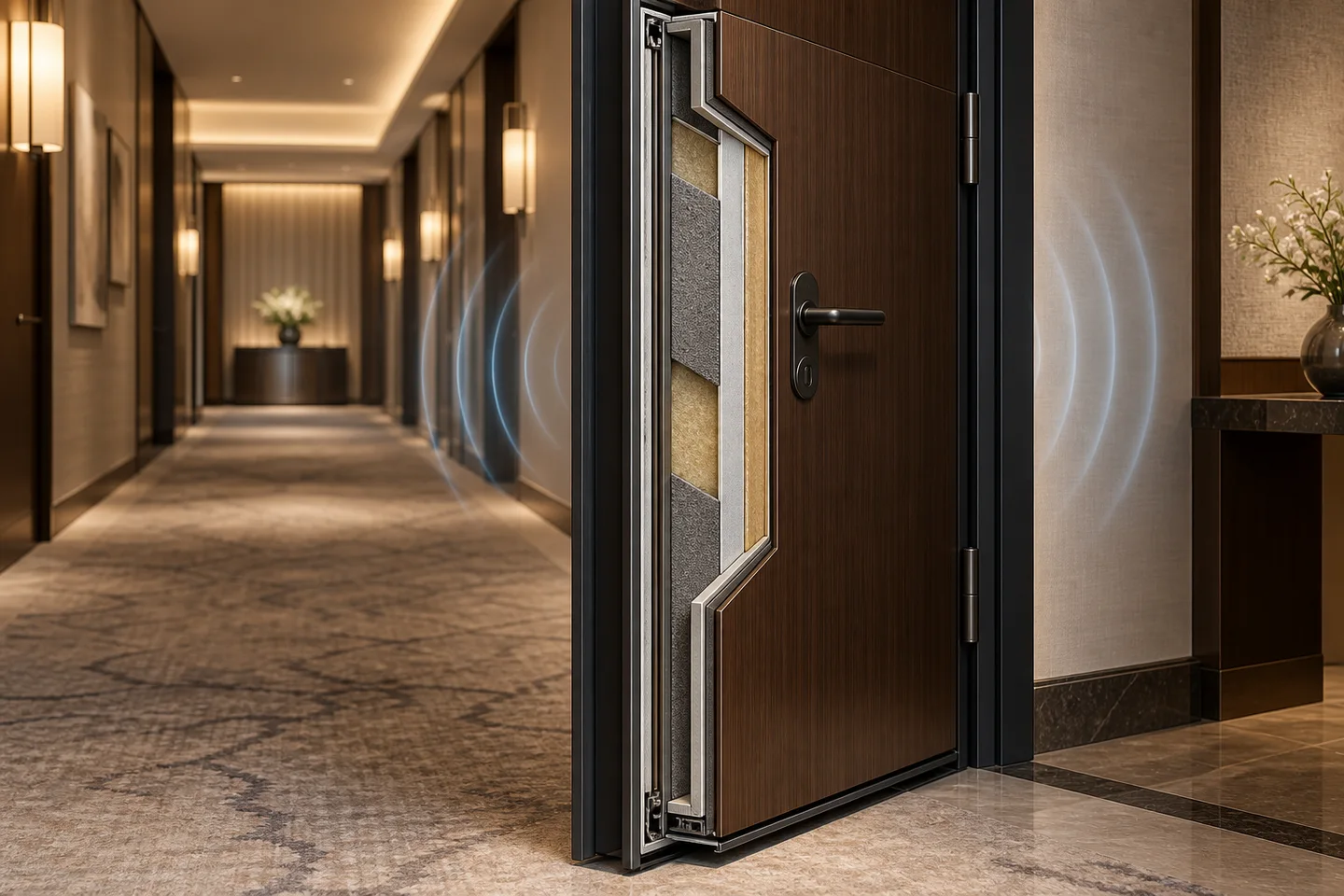
How STC ratings work, what STC 35+ blocks in practice, and the core, seals and threshold engineering behind a quiet entrance.
Buyers ask for a “soundproof” door; engineers specify an STC-rated doorset. STC 35 is a practical entrance-door target when loud speech should remain audible but not clearly intelligible; STC 40 provides stronger speech privacy. The correct target still depends on the room, background noise and the tested complete assembly.
Project buyers should evaluate acoustic performance together with security, fire, hardware and installation requirements. WONLY's acoustic and STC-rated entrance door solution maps the target, test evidence, seals, hardware and site-acceptance inputs into one project brief, while the security door manufacturer overview covers the wider sourcing process.
What STC Actually Measures
Sound Transmission Class rates how much airborne sound a partition blocks across the speech-frequency range — the higher, the quieter. As rough reference points: at STC 25 normal speech is easily understood through the door; at STC 35 loud speech is audible but not intelligible; above STC 40 loud speech becomes a murmur. Every 10-point gain is a large, clearly perceptible improvement.
Is STC 35 Good for a Door?
For many apartment entrances, hotel guestrooms and homes beside shared corridors, STC 35 is a useful specification starting point. Choose STC 40 or higher when speech privacy is more important or the source level is higher. Do not select the number alone: ask for the laboratory report covering the leaf, frame, seals, threshold, glazing and hardware configuration you will actually purchase.
Where Door Sound Actually Leaks
- The gap under the door — the single biggest leak on most entrances
- Perimeter gaps between leaf and frame without continuous sealing
- A hollow, resonant core that transmits mid frequencies
- Letterplates, vision panels and hardware cut-outs
How a Security Door Gets Quiet
The same construction that stops intruders helps stop noise: a dense, layered core; a tight, reinforced frame; continuous perimeter seals; and an automatic drop-seal that closes the under-door gap when the leaf shuts. WONLY doors combine a cast-aluminium shell with a honeycomb steel core, precision perimeter sealing and a sinking drop-seal threshold, achieving STC 35+ on applicable series — a level at which corridor conversation stops being your living-room soundtrack.
Specifying Acoustic Performance
- Ask for a tested STC (or Rw) figure for the whole doorset, not a core-material claim
- Confirm the drop-seal and perimeter seals are included in the tested configuration
- For hotels and apartments, put STC 35+ in the tender line item
STC and Rw Are Not Interchangeable Labels
STC is commonly used in North American specifications, while Rw is used in many international and European contexts. Both are single-number ratings derived from laboratory frequency-band measurements, but their calculation rules differ. Do not convert one to the other with a fixed subtraction or treat two similar numbers as automatically equivalent. Request the original report, identify the test standard and compare the exact doorset configuration.
Turn the Rating into an Inspectable Requirement
An acoustic line item should identify the laboratory rating, test standard, doorset size, frame, seals, threshold, hardware and installation boundary. At submittal, compare the proposed opening with the tested specimen. At handover, inspect clearances, seal compression, threshold contact, latching and the frame-to-wall perimeter. This closes the gap between a laboratory number and the installed result.
For projects that also require forced-entry or fire performance, coordinate all three requirements before approving hardware substitutions. A lock, viewer, cable route or closer preparation can affect more than one tested characteristic.
For a project review, send the opening schedule, wall type, target rating and hardware list through the WONLY project enquiry form. If the same opening also needs fire resistance, compare the tested assembly requirements in the fire-rated security door solution.
FAQ
Does a higher security grade mean better acoustics? Often they travel together — denser cores and tighter frames serve both — but only a tested acoustic figure proves it. Specify both numbers separately.