Buying Guide
Understanding Security Door Ratings and Certifications for Import Markets
2 April 2026
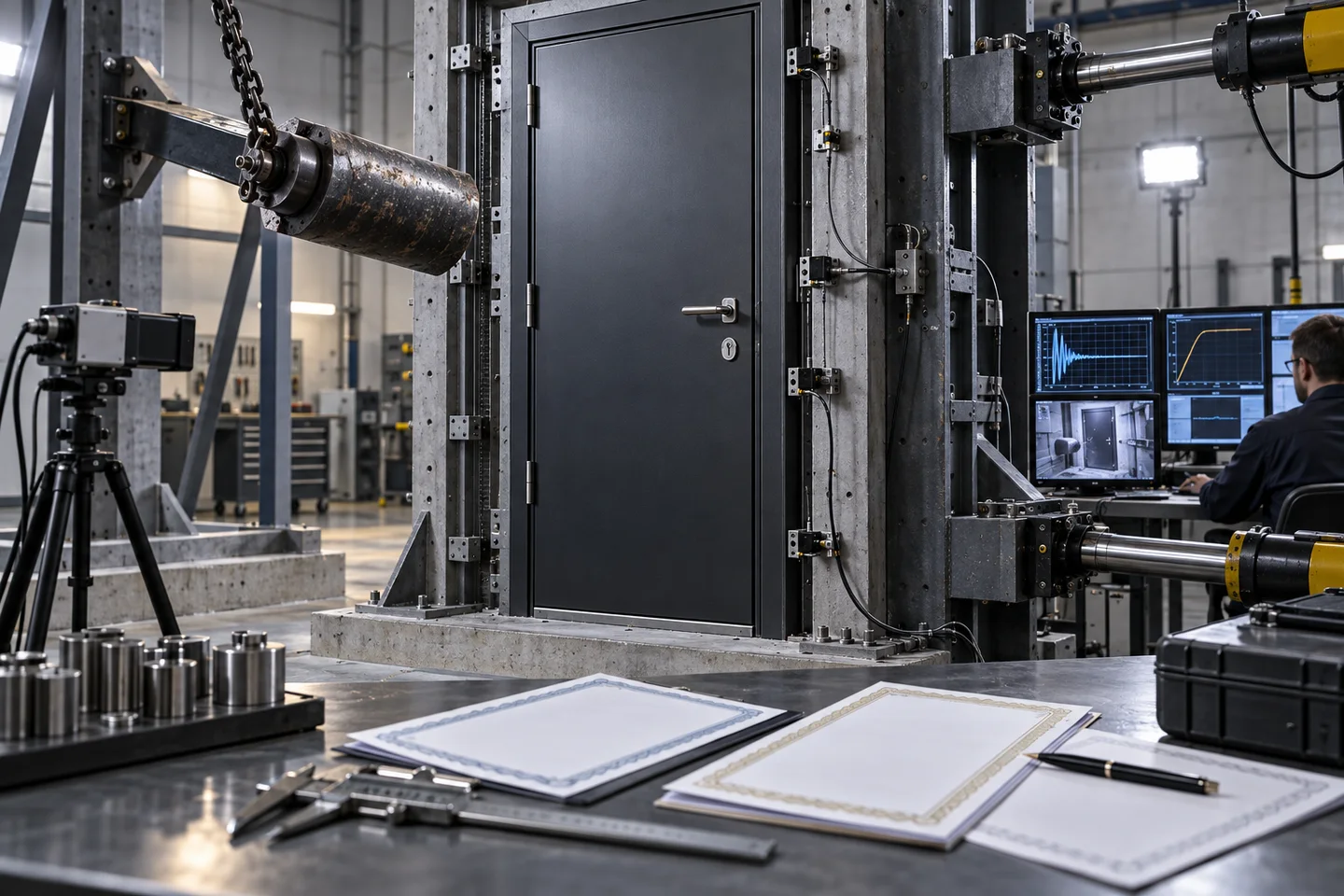
EN 1627 RC2–RC6, GB 17565 grades and fire ratings decoded — what the classes mean and how to choose the right protection level for your market.
When buyers compare security doors, one question comes up before price, finish or lead time: how secure is it, really? A rating only means something when it is independently tested. This guide explains the security-door ratings and protection levels that matter for importers, developers and project buyers.
Why Security Door Ratings Exist
A security-door rating is an independently tested measure of how long, and against which tools, a door resists forced entry — a class a test lab has verified, not a marketing claim. Two standards dominate international sourcing: EN 1627 (Europe and most export markets) and GB 17565 (China, where a large share of the world's security doors are made). Fire performance is rated separately.
EN 1627: Burglar-Resistance Classes RC2–RC6
EN 1627 is the European standard for the burglar resistance of doors and windows. It defines resistance classes RC1 to RC6, each set by the attacker profile, the tools allowed and the minimum time the door must hold:
- RC2 — casual burglar with screwdriver and pliers, about 3 minutes: apartments and low-risk residential
- RC3 — experienced burglar adding a crowbar, about 5 minutes: villas and ground-floor homes
- RC4 — seasoned burglar with saw, hammer and cordless drill, about 10 minutes: high-value residential and light commercial
- RC5 — adds power tools, about 15 minutes: commercial and institutional
- RC6 — heavy power tools, about 20 minutes: banks, vaults and high-security sites
For most residential export projects, RC2 to RC3 is the practical sweet spot; RC4 and above is specified for commercial, institutional and high-risk applications.
Use the detailed EN 1627 RC2, RC3 and RC4 comparison to map attacker tools, laboratory resistance time and project use to each opening.
GB 17565: China's Security Door Grades
Because so many security doors are manufactured in China, buyers should also recognise GB 17565, China's technical standard for burglar-resistant doors. It classifies doors into grades — A, B, C and D — based on the net working time an attacker needs to break through, with Class A resisting the longest. A reputable China-based manufacturer can supply doors certified to both GB 17565 and EN 1627 — which is what international buyers should ask for.
Fire Ratings Are Separate
A door can be burglar-resistant and fire-rated, but these are two different tests. Fire performance is measured to EN 1634-1 (or UL 10C in North America) in minutes of integrity and insulation — 30, 60, 90 or 120 minutes. For hotels, hospitals, apartment corridors and public buildings, a fire rating of 60–90 minutes is usually mandatory alongside security.
Beyond the Class: What Makes a Door Hold
- Lock and cylinder grade — the lock is the most-attacked point; anti-drill, anti-bump cylinders matter
- Multi-point locking — bolts engaging the frame at several points resist prying
- Frame and hinge strength — a strong leaf on a weak frame still fails
- Cycle testing — a quality door is tested to 200,000+ open/close cycles
How WONLY Doors Are Rated and Tested
WONLY has manufactured security doors since 1996 and is a listed company (SSE: 605268), backed by 1,000+ patents and 30 years with zero major safety incidents. Its security doors are independently tested against the standards above:
- Class A — the highest China GB 17565 burglar-resistance grade
- EN 1634 fire-rated — 90-minute integrity, compliant with Gulf, SE Asia and Central Asia codes
- 200,000+ open/close cycle tested, plus forced-entry testing
- Certified to ISO 9001, ISO 14001, CE, UL, CMA and CSPA
- Hurricane-rated (wind Class 12) and acoustic STC 35+ on applicable series
FAQ
What is the most common security door rating for homes? RC2 for apartments and RC3 for villas and ground-floor homes are the most widely specified residential classes.
Can one door be both fire-rated and burglar-resistant? Yes — a well-engineered door can carry an EN 1627 burglar-resistance class and an EN 1634 fire rating at the same time.