Technology
Door Core vs Cylinder: Lock Core, Cylinder and Lock Body Explained
9 September 2026
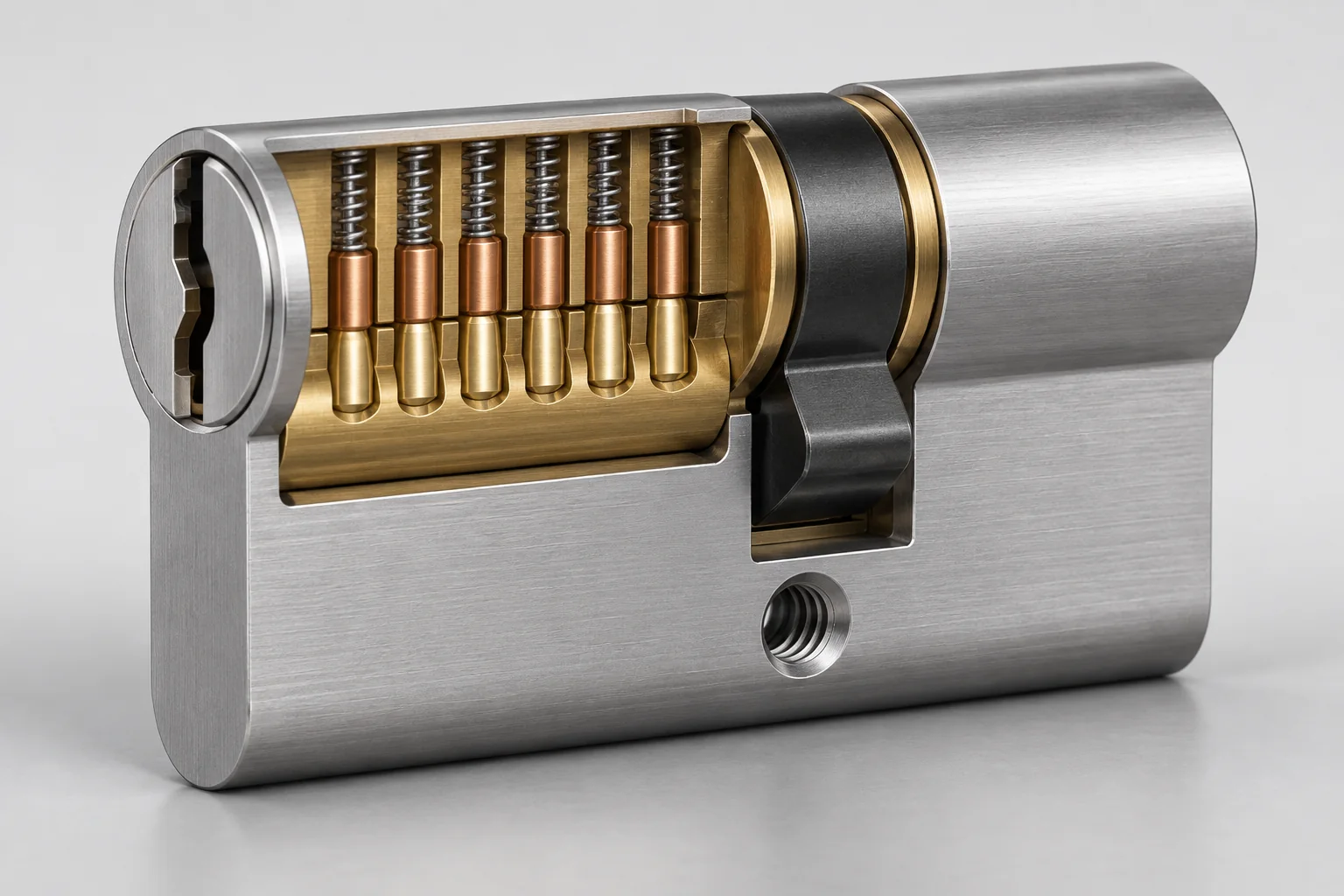
Lock core and cylinder are often used as synonyms, but buyers still need to compare the complete cylinder format, protection and test evidence.
In door-hardware language, door core, lock core and lock cylinder are sometimes used for the same replaceable keyed component, but they are not always technically identical. “Core” can mean the removable inner unit, while “cylinder” usually means the complete housing installed through the lock or door. The exact meaning depends on the lock format, so buyers should compare drawings and part numbers rather than relying on the label alone.
Short answer: a lock cylinder is normally the complete keyed housing; a lock core may mean that whole cylinder in general conversation or the removable inner unit in an interchangeable-core system. Neither term means the mortise lock body inside the door.
Lock Core vs Cylinder at a Glance
- Lock cylinder — the complete keyed cylinder assembly, including its housing, plug or core, pins and cam or tailpiece
- Lock core — sometimes a general name for the cylinder; in an interchangeable-core system, specifically the removable inner unit
- Door lock body — the larger mortise or locking mechanism operated by the cylinder; it is not the cylinder itself
- Best comparison method — confirm the profile, dimensions, attack protection, escutcheon, replacement method and test evidence for the proposed doorset
For the common search question “door core vs cylinder,” the practical answer is simple: the cylinder is normally the complete keyed assembly; the core is either its removable inner component or an informal name for that assembly. The lock body is a separate mechanism inside the door.
Euro Cylinder vs Interchangeable Core
A Euro-profile cylinder is a complete cylinder format shaped to fit a compatible mortise lock case. It may be supplied as a single, double or thumbturn cylinder and must match the door thickness, cam and lock case. An interchangeable core is a removable keyed unit designed to be extracted from its housing with an authorised control key. The formats are not interchangeable simply because both contain a key plug.
Before ordering a replacement, verify:
- The cylinder or core profile and manufacturer system
- Overall length and the inside/outside split relative to door thickness
- Cam, tailpiece or actuator geometry
- Single, double, thumbturn or emergency-function operation
- Keying requirement: keyed different, keyed alike or master keyed
- Projection beyond the escutcheon and the required anti-snap, anti-drill and anti-pick protection
If any of these details differ, a part described generically as a “lock core” may not fit or operate the existing lock body.
Attackers commonly target the cylinder rather than the door slab because it can expose the locking mechanism. Many doors use a conventional figure-eight or euro-profile cylinder with a brass body, rotating plug and exposed keyway. Its real resistance depends on projection, material, anti-snap geometry, drill protection and the protective hardware around it.
How Standard Cylinders Fail
- Snapping — grip the protruding brass body with pliers and twist; the cylinder breaks at its narrow waist
- Bumping and picking — a standard pin-tumbler keyway yields to bump keys and picks in minutes
- Drilling — brass offers little resistance to a cordless drill through the shear line
This is why forced-entry statistics are dominated by cylinder attacks: they are fast, quiet and tool-light.
A Different Geometry: The Cylindrical Core
WONLY replaced the gourd format outright. Its patented cylindrical lock core — an industry-exclusive design — presents no gripping waist to snap, uses a hardened construction a drill will not bite into, and a mechanism whose resistance to technical (non-destructive) opening exceeds the top national requirement by a wide margin — up to 36 times the highest standard's threshold. In practical terms: locksmiths who advertise opening every lock routinely make an exception for this one.
The Core in the System
A cylinder is only as good as the doorset around it. In WONLY doors the cylindrical core sits behind a reinforced escutcheon in a leaf with 16-bolt four-edge mechanical self-locking, certified to GB 17565 Class A and cycle-tested past 200,000 operations — so the strongest core in the industry is not compensating for weakness elsewhere.
What Buyers Should Ask Any Supplier
- What cylinder format does the door use — and is it the same brass gourd as everyone else?
- Show the technical-opening test result against the national standard
- Is the core anti-drill by material, not just by a hardening pin?
- Full forced-entry and technical-opening reports are available from WONLY on request
Can You Replace Only the Core or Cylinder?
Often yes, but replacement scope depends on the installed system. A removable interchangeable core may be changed without removing the housing. A Euro-profile cylinder is normally removed as a complete cylinder after releasing its fixing screw. Proprietary cylindrical formats require the matching authorised component and service procedure. For project schedules, record the exact manufacturer, profile, length, cam and key system instead of writing only “replaceable core.”
FAQ
Is a door core the same as a lock cylinder? Sometimes in everyday product language, but not always. A complete cylinder includes the housing and operating parts; “core” may refer only to the removable keyed unit. Confirm the drawing, profile and part number before specifying replacements.
Can the cylindrical core be rekeyed or replaced? Yes — it is serviceable through authorised channels; what it resists is unauthorised attack, not legitimate maintenance.
Is an interchangeable core the same as a euro cylinder? No. An interchangeable core is a removable core format designed for rapid authorised replacement; a euro-profile cylinder is a complete profile and housing format. Compare drawings, dimensions and the surrounding protective hardware.
Is the lock body the same as the cylinder? No. The cylinder accepts the key or credential and transfers rotation; the lock body contains the latch, deadbolt or multi-point mechanism inside the door.
To evaluate the core, escutcheon, lock body and doorset together, send the proposed hardware schedule through the WONLY project enquiry form or review the security door manufacturer capability page.